Vibe coding opens the gate and raises new doubts
A 30-year-old music producer with chronic health problems wrote that he had “dreamed about making a game since I was 7 or so,” and that coding was the thing that “held me back for all these years.” Then AI arrived. “Made my first game completely vibe coded in Unity, with no programming experience,” he posted. “Now with vibe coding I can create whatever I have in my head.” [54]
That is the appeal of vibe coding: not just speed, but permission. For people who long saw software as a closed craft, AI coding tools can make building feel reachable in a new way. Across Reddit and X, posters describe prompting, steering, patching, and shipping with a confidence that would have been harder to imagine a few years ago. [21] [54]
The excitement meets suspicion almost at once. In the same feeds that celebrate AI-built apps, critics point to bloated code, generic interfaces, and creators who can ship faster than they can explain what they made. [3 refs]Citations[32][33][38] The argument around vibe coding is no longer whether it exists. It is whether cheaper creation improves software, or simply changes who gets to make more of it.
A door swings open
The emotional force behind vibe coding is easy to spot in posts like that Unity game maker’s. AI was not framed as a workflow improvement. It was framed as access to a dream that had been deferred for years. [54]
That helps explain why the language around the practice is so sweeping. Andrej Karpathy’s phrase has become a banner in AI-tool circles, and one widely shared post described a world in which “Claude Skills, MCP servers, and AI agents are past the hype and are now the new baseline for building.” [21] Garry Tan put the mood in simpler terms: “Everyone will code and it will be glorious.” [4]
Some users talk as if software work has already changed for good. One Reddit post, citing Karpathy, said “software development has changed for good.” [48] Whether that claim holds is unsettled, but the feeling matters: many people now talk as if software is something they can finally touch. [48] [54]
The new indie dream: ship first, understand later
The energy is loudest in public-building culture, where AI fits neatly into an older startup instinct: launch quickly, narrate the process, and let attention help carry the project. Builders are using AI to make “real-time apps for your audience,” including “polls, quizzes, multiplayer games, chats,” and one Reddit user posted, “I vibecoded a Linux like shell for windows.” [2] [50]
Attention is part of the product. One builder wrote, “I built this last week, woke up to a developer with 28k followers tweeting about it, now PRs are coming in from contributors I’ve never met.” [25] Another wrote, “Your 937 upvotes kept yoyo alive. 17 days later, here’s what 200 lines evolved into.” [26]
There are enough wins to keep the mood high. “My vibe coded app is ranking top 150 in app store charts!” one builder posted. [40] Another shared a smaller milestone that may say more about the scene: “The paid user ACTUALLY liked the tool. I feel proud.” [44]
Still, the rhetoric of ease can hide the hours. One founder wrote, “I spent 1.5 years building a free all-in-one productivity app.” [20] A law student posted, “took 300+ hours but launched a fantasy baseball advanced stat app while in law school during my free time.” [52] And in a forum for AI builders, a newcomer asked the plain question sitting under the boom: “How are people actually making money with agentic AI?” [13]
Software as self-expression
Not all of this energy is aimed at SaaS. Some of the clearest examples look more like toys, art projects, or personal obsessions.
A mixed-reality app “lets you create and ride thrilling rollercoasters in your own living room,” one post said, using “physics-based tools to design tracks that adapt to your space.” [6] Another celebrated someone who “VIBE CODED A FULL FLIGHT COMBAT SIMULATOR” in the browser, complete with “dogfights,” “heat-seeking missiles,” “flares,” and “real-world terrain.” [15] A third builder wrote that an interactive slides tool had become “my default way of making slides,” adding, “Bye powerpoint.” [39]
The ethos can be intensely personal. One builder wrote, “I kept waiting for someone to build this. Nobody did. So I built it myself.” [51] Another described a tool for “vibe-coding real-time apps for your audience” that could generate collaborative experiences “local-first and crazy fast.” [2]
Taken together, those posts suggest that AI coding tools are not only being used to automate work. They are also being used to make odd, playful, or highly specific things that their creators wanted to exist. [5 refs]Citations[2][6][15][39][51]
Then comes the audit
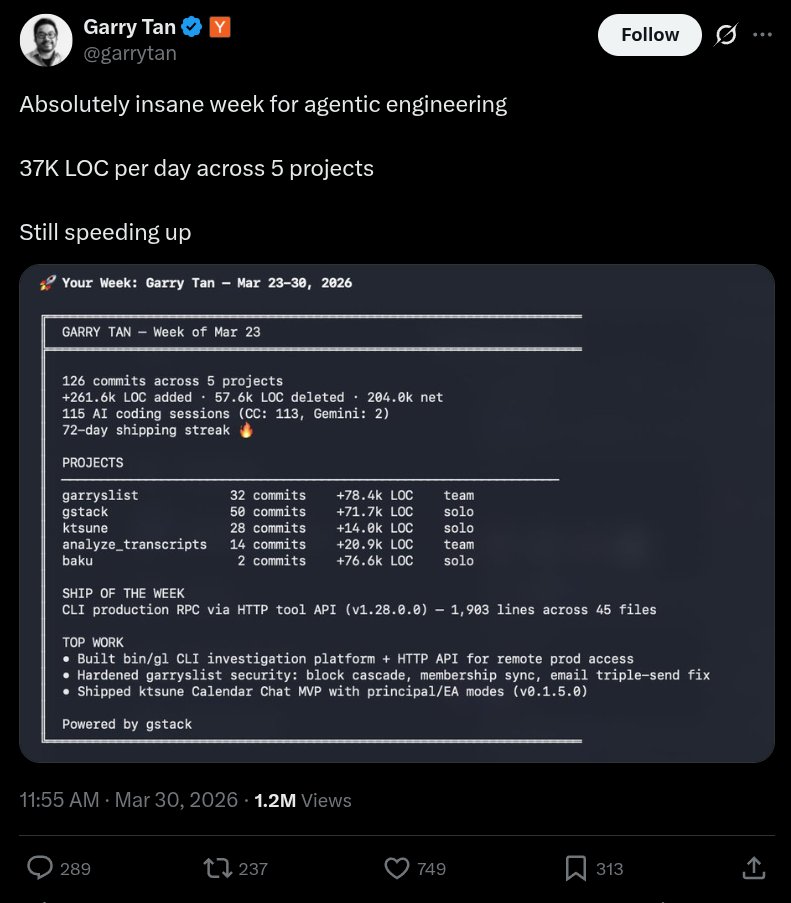
One backlash moment was brutally concrete. “I audited Garry’s website after he bragged about 37K LOC/day and a 72-day shipping streak,” a critic wrote. What he found, he said, was “78,400 lines of AI slop code” and “a single homepage load” that “downloads 6.42 MB across 169 requests. for a newsletter-blog-thingy.” [33]
The complaint was not only that AI code can be wrong. It was that it can feel wrong in a recognizable way: padded, repetitive, and oddly impersonal. One post mocked a common UI tell: “these little side tabs are like the emdash of vibe coded UIs.” [38]
Mockery has become part of the backlash. One Reddit user reacted to a release note with, “Is this a joke?” [12] Another parodied AI-product grandiosity with a “revolutionary software application” called “NoteClaw,” whose “Groundbreaking Features” amounted to little more than a blank writing box and contempt for “features,” “options,” and “design.” [43] On X, a sarcastic post about Tesla-style hype — “LOOK HOW MUCH TIME I SAVE MUCH IMPRESS. VERY WOW” — captured another irritation: not just the products, but the chest-thumping around them. [1]
That reaction has helped bring an old software word back into circulation: taste. Not lines shipped per day. Not benchmark claims. Taste. The term is hard to measure, which may be why it keeps returning. [33] [38]
Faster, and maybe dumber
Some of the sharpest criticism comes from people who use the tools themselves. One Reddit poster argued that AI coding is not one thing but “a few different approaches,” from fast “prompt -get code - fix - repeat” loops to more structured, plan-first workflows. He added a warning: the loose style works “for small tasks, but can get weird as projects grow.” [16]
Another builder put the tradeoff more starkly. “Vibe coding is making us 10x faster but 100x dumber,” he wrote. He had “Built my MVP in 3 days with Claude,” then hit “a weird auth bug.” After “4 hours ‘prompting’ the AI to fix it,” the model would “hallucinate and break everything else.” Only when he “deleted the AI mess” and inspected the logic himself did he fix the problem “manually in 20 minutes.” His conclusion: “I feel like I’m becoming a manager of a codebase I don’t even understand.” [32]
That may be the central tension. AI can shrink the distance between idea and artifact while widening the distance between artifact and comprehension. [16] [32] The old work of software still shows up when something breaks: “Boris Cherny was tracking down a memory leak,” one post noted. [56] Another captured the older misery in a single line: “How you feel seeing this diagnostic at 3:27 AM.” [57]
Why the engineers are not gone
The replacement rhetoric is loud. “The era of human coding is over,” one Reddit post declared. [41] It is the kind of sentence that spreads because it flatters both fear and fantasy.
Direct experience sounds less tidy. One developer wrote that he had been “very pessimistic about AI taking jobs” until “a vibe coder joined my team.” The new colleague wanted to handle model training independently; a week later, the developer realized progress had stalled. The point was not that AI was useless. It was that AI-assisted output and engineering judgment were not the same thing. [29]
That distinction gets blurred online because people use coding to mean different activities. One is generating and assembling working software with AI help. The other is owning a system over time: understanding architecture, handling edge cases, diagnosing failures, and making choices whose costs may not appear until later. [29] [32]
As systems get more consequential, that gap matters more. If the software handles authentication, model training, or a business that can fail in public, someone still has to be responsible when “everything is good” turns out not to be true. [3 refs]Citations[29][32][56]
The hype machine behind the keyboard
The tools are improving quickly. The marketing around them moves even faster.
“Cursor just dropped Composer 2,” one viral post announced, calling it “their own AI model” and claiming it “beats Claude Opus on coding benchmarks.. at a fraction of the cost.” [10] Another promoted Replit’s “Agent 4” as “The first AI that designs, builds, and ships production apps in parallel,” with the usual modern-tech numbers attached: “50 million builders,” “$9B valuation,” and “10x faster than any vibe coding tool.” [28] Elsewhere, a company account declared, “Issue tracking is dead. We are building what comes next.” [22]
Users do report real value. One post praised an orchestration product as “by far the best,” saying, “I have walked away for days at a time. Automate huge tedious tasks and take your family out or something.” [34] Another marveled that “1.4m views on this post after just over an hour is INSANE for a feature release,” a sign of how much attention coding-tool launches now attract. [47]
Even so, some insiders warn that benchmark theater can distort the picture. “everyone’s gaming the benchmarks. We did it to prove a point,” one poster wrote. [59] Another said, “Eval results aren’t the only thing that matter.” [58] For users, that leaves a familiar problem: the products are changing fast, and the claims around them are changing faster.
Feed-bias disclosure: many cited posts come from social feeds that reward novelty, hype, and conflict, so the loudest examples are not always the most representative. [5 refs]Citations[10][28][47][58][59]
Who owns the future you are building?
The politics of vibe coding do not always announce themselves, but they are there. Empowerment can arrive with new dependence.
One Reddit post warned, “If you don’t opt out by Apr 24 GitHub will train on your private repos.” [5] Another user described turning “my personal Perplexity plan into an MCP” and wishing the company “would officially allow this instead of requiring a separate API plan.” [14] The details differ, but both posts point to the same anxiety: the tools that help people build can also set the terms of access. [5] [14]
Platform control shows up elsewhere too. “Apple is scared of vibe coding they removed Anything from the App Store so we moved app building to iMessage,” one company account claimed. [37] At the ecosystem’s edge, there is also a more improvisational instinct. One post celebrated the chance to “reverse engineer website APIs from inside your browser.” [42]
That is one reason open alternatives draw attention. Mistral’s “Leanstral” was released as “the first open-source code agent for Lean 4” under “an Apache 2.0 license,” framed as a base for “verifiable vibe-coding.” [24] “Open Claude v0.1.7 is live and now 6K stars!” another post said. [49] Those projects do not erase dependence, but they do show that some builders would rather shift power than accept a stack of closed intermediaries. [24] [49]
A new literacy, not a magic wand
Some of the more thoughtful practitioners already describe vibe coding as a craft that has to be learned. One Reddit user hosted an AMA after spending “a whole year mastering my vibe coding skills and how to work with AI coding agents.” [11] Another described “different ways people are using AI to code,” contrasting quick prompting with more deliberate planning and orchestration. [16]
That literacy now includes distribution as much as code. A side project can gather force through architecture docs, GitHub stars, and the right burst of social attention. “Woke up to a developer with 28k followers tweeting about it,” one builder wrote, before pull requests started arriving. [25] Another celebrated “10k stars on GitHub” for a slide-making tool that had become many users’ “default way of making slides.” [39] A third exclaimed, “WOW! 1000 stars in just a day is crazy!” while promising improvements to “UI/UX.” [60]
There are also hints that AI fluency is turning into labor-market currency. One poster in an AI work forum wrote, “2 instant offers in 6 hours,” adding, “3 projects on the go this week.” [53] That does not mean everyone becomes a software engineer in the old sense. It may mean more people become competent directors of software: able to describe, iterate, test, and ship, while still needing judgment when the generated scaffolding starts to wobble. [5 refs]Citations[11][16][32][53][56]
The man who finally built his childhood game was not thinking about benchmark gaming, App Store gatekeeping, or a 6.42 MB homepage when he sat down with Unity and an AI assistant. He was thinking about a dream he had carried since he was seven. [54]
That is why vibe coding will keep pulling people in. It offers a feeling that software rarely offered at scale before: you can try. The harder part starts after that, when the thing you made has to survive contact with users, bugs, platforms, and your own limits. And that is where the vibes end and the work begins.